
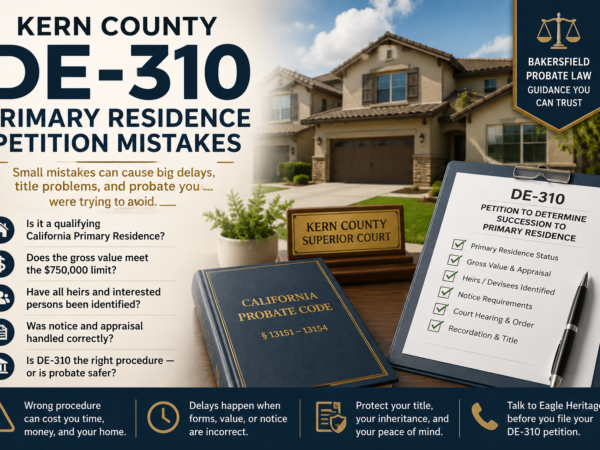
California’s DE-310 primary residence petition can be a powerful tool when a deceased person left a qualifying California home. However, DE-310 primary residence petition mistakes can easily occur if the process is misunderstood. The $750,000 rule is not a universal small estate limit, and DE-310 primary residence petition mistakes can arise if it is assumed to apply to every house, every parcel, every rental property, or every estate.
In Kern County, a DE-310 primary residence petition mistake can cause delay, probate notes, rejected paperwork, title problems, family disputes, or the need to open formal probate later. The petition may appear simple, but it asks the court to determine who succeeded to real property, which can lead to DE-310 primary residence petition mistakes if not done correctly. Avoiding common DE-310 primary residence petition mistakes is crucial to ensure a smooth process.
For the broader overview, start with Small Estate Transfers.
Understanding DE-310 primary residence petition mistakes is critical for families navigating estate transitions.
What is a DE-310 primary residence petition?
A DE-310 primary residence petition is a court petition asking the superior court to determine that a deceased person’s qualifying California primary residence passes to the proper successor without a full probate administration. For deaths on or after April 1, 2025, and before the next scheduled adjustment period, the gross value limit for the qualifying primary residence procedure is $750,000. (Prob. Code, §§ 13151–13154.)
This is not the same as an ordinary small estate affidavit. It is not handed to a bank. It is filed with the court. It requires a court order. And if real estate title is involved, the order and recording process matter.
One must be careful to avoid DE-310 primary residence petition mistakes that can complicate the filing process.
Many families face DE-310 primary residence petition mistakes due to misunderstandings of the rules.
Identifying DE-310 primary residence petition mistakes before filing can save time and reduce complications.
To avoid DE-310 primary residence petition mistakes, ensure all necessary documentation is prepared accurately.
Do not treat DE-310 as a quick house-transfer form. If the value, residence status, heirs, notice, appraisal, or title facts are wrong, the shortcut can create more delay and cost than doing the procedure correctly from the beginning.
Understanding specific DE-310 primary residence petition mistakes can clarify expectations during the estate transition.
What are the most common DE-310 mistakes in Kern County?
These DE-310 primary residence petition mistakes can hinder the timely transfer of property.
Clarifying DE-310 primary residence petition mistakes helps prevent future legal issues for families.
Awareness of DE-310 primary residence petition mistakes is vital for navigating the probate process.
The most common DE-310 mistakes are assuming the $750,000 rule applies to every property, filing for a non-primary residence, using the wrong date-of-death limit, relying on equity instead of gross value, failing to obtain the correct appraisal, omitting heirs or devisees, mishandling notice, ignoring a pending probate case, and assuming the court order will automatically solve title or family disputes.
Understanding these DE-310 primary residence petition mistakes is crucial for ensuring a smooth process.
Many of these mistakes happen because the family is trying to avoid probate quickly. Speed is understandable. But with inherited real estate, moving too quickly can leave ownership unclear.
Mistake 1 — Treating the $750,000 rule as a universal small estate limit
By avoiding common DE-310 primary residence petition mistakes, families can ensure a smoother transition and preserve the value of the estate.
The $750,000 rule is not a universal California small estate limit. It is tied to a specific primary-residence procedure under Probate Code sections 13151 through 13154.
That means the rule does not automatically apply to:
- Bank accounts.
- Vehicles.
- Investment accounts.
- Rental houses.
- Vacation homes.
- Vacant land.
- Commercial property.
- Non-primary residence parcels.
- Real estate outside California.
If the property is not the decedent’s California primary residence, a DE-310 petition may be the wrong procedure. The family may need a different small estate procedure, a spousal property petition, or formal Decedent Estate Administration.
Mistake 2 — Filing DE-310 for property that was not the decedent’s primary residence
DE-310 is focused on a primary residence. The petition asks for facts showing that the real property was the decedent’s primary residence in California. (Prob. Code, §§ 13151, 13152.)
This can become a problem when the decedent owned more than one property, lived with family, spent time in a care facility, rented out the property, moved before death, or used the property as an investment. The question is not simply whether the decedent owned a house. The question is whether the property fits the statutory primary-residence procedure.
If the facts are unclear, do not assume. A weak primary-residence claim can trigger objections, probate notes, court delay, or title-company problems later.
Mistake 3 — Using the wrong date-of-death value limit
Each mistake related to DE-310 primary residence petitions can lead to significant delays and confusion.
The applicable value limit depends on the date of death, not the date of filing.
For deaths on or after April 1, 2025, and before April 1, 2028, the DE-310 primary residence limit is $750,000. Earlier deaths may be subject to different limits. California also adjusts certain probate dollar amounts periodically, so the current DE-300 values should be checked before filing. (Prob. Code, § 890; Prob. Code, §§ 13151–13154.)
This mistake is common because people hear “$750,000” and assume the number applies whenever they file. It does not. The decedent’s date of death controls the value period.
For related value-limit issues, review What counts toward California’s small-estate limit?.
Mistake 4 — Using equity instead of gross value
DE-310 focuses on the gross value of the decedent’s interest in the primary residence, as shown by the required appraisal. Families sometimes look only at equity after the mortgage and assume the property qualifies. That can be a serious mistake.
If a house is worth $800,000 but has a $300,000 loan, the family may think the “real value” is $500,000. But small estate procedures often use gross value rather than the family’s net-equity estimate. The petition must be evaluated carefully before filing.
A value mistake can derail the petition, create title concerns, and waste time that could have been spent on the correct procedure.
Mistake 5 — Skipping the probate referee appraisal
The DE-310 process requires attention to appraisal. Probate Code section 13152 requires an inventory and appraisal, and the appraisal must be made by a probate referee selected from those appointed for the county where the real property is located. (Prob. Code, § 13152.)
This is not the same as a Zillow estimate, tax assessment, broker opinion, refinance appraisal, or family guess. If the appraisal is missing, incomplete, or not prepared correctly, the petition may be delayed or challenged.
For Kern County filings, confirm that you are using the current Judicial Council forms, the correct local procedures, and any local supplement or probate-note requirements that apply before filing.
Learn from past DE-310 primary residence petition mistakes to facilitate smoother transitions.
Mistake 6 — Failing to identify heirs, devisees, and interested people
A DE-310 petition is not just about the house. It is also about who is legally entitled to receive the decedent’s interest in the house.
The petition must address heirs, devisees, executors named in a will, trustees in some situations, guardians or conservators, and other persons whose rights may matter. (Prob. Code, § 13152.) If the petition leaves out a child, spouse, registered domestic partner, beneficiary, executor, trust interest, or person entitled to notice, the case can become contested or delayed.
This is especially risky when:
- The decedent had children from more than one relationship.
- The decedent was separated but not divorced.
- A surviving spouse or registered domestic partner exists.
- There is a will, trust, amendment, or disputed estate plan.
- Someone claims the decedent promised them the house.
- A family member is already living in the property.
- One heir wants to sell and another wants to keep the home.
If the decedent left a surviving spouse or registered domestic partner, a Spousal Property Petition may also need to be considered. (Prob. Code, §§ 13500–13660.)
Mistake 7 — Mishandling notice
Notice is not a minor detail. Probate Code section 13153 requires notice of the hearing to be given to the persons named in the petition under Probate Code section 13152. (Prob. Code, §§ 13152, 13153.)
If required people are not named or properly notified, the court may not be able to grant the petition. A title company may also question whether the court order truly resolved ownership if the process missed someone with a possible claim.
Notice mistakes are especially dangerous when the family is already divided. A person who was ignored may later challenge the transfer, block a sale, or create a title dispute.
Mistake 8 — Ignoring an existing probate case
DE-310 is designed for situations where no California estate administration is being or has been conducted, unless the personal representative consents in writing to use the procedure. (Prob. Code, §§ 13151, 13154.)
Avoiding DE-310 primary residence petition mistakes is essential for a successful property transfer.
If someone has already opened probate, or if Letters have already been issued, the DE-310 path may not be available without consent. Filing as if no probate exists can create avoidable delay and confusion.
Before filing, check whether a probate case has already been opened in Kern County or another California county. Also check whether estate proceedings have occurred in another jurisdiction.
Mistake 9 — Assuming the court order automatically clears every title problem
A successful DE-310 petition may produce a court order determining succession to the primary residence. But that does not automatically solve every future title, sale, occupancy, tax, lien, deed, or family-control issue.
The order still needs to be handled correctly. The legal description, Assessor’s Parcel Number, property interest, recording process, and follow-up with title or escrow can matter. A mistake in the order or recording chain can create a problem when the family later tries to sell, refinance, buy out an heir, or insure title.
If the issue involves unclear ownership, old deeds, title-company refusal, or defective records, review Clearing Title Records.
Mistake 10 — Using DE-310 to avoid a family dispute
A DE-310 petition works best when the facts are clean. It becomes risky when the family is fighting about who inherits, who can occupy the house, whether the property should be sold, who paid expenses, or whether someone had authority to act before the court order.
If someone is already living in the house, blocking access, collecting rent, refusing to sell, claiming a side agreement, or pressuring others to sign paperwork, the problem may no longer be a simple small estate transfer. It may be an Inherited Property Dispute.
Do not use DE-310 as a substitute for resolving a real dispute. A shortcut does not make conflict disappear. It can make the conflict more expensive if the wrong facts are presented to the court.
What should you check before filing a Kern County DE-310 petition?
Before filing a Kern County DE-310 primary residence petition, check:
- The decedent’s exact date of death.
- Whether at least 40 days have passed.
- Whether the property was the decedent’s California primary residence.
- The gross value of the decedent’s interest in the residence.
- Whether the correct probate referee appraisal has been prepared.
- Whether the current DE-300 values are attached when required.
- Whether there is a will, trust, amendment, or estate plan.
- Whether all heirs, devisees, and required interested persons have been identified.
- Whether anyone must receive notice of the hearing.
- Whether a California probate case already exists.
- Whether another jurisdiction has handled any estate proceeding.
- Whether a surviving spouse or domestic partner has a better procedure.
- Whether the legal description and Assessor’s Parcel Number are correct.
- Whether recording, title, escrow, or sale issues are already expected.
- Whether family conflict makes formal probate safer.
If any of these points are uncertain, talk to a lawyer before filing. The cost of correcting a defective real estate transfer can be much higher than getting the procedure right at the beginning.
When is formal probate safer than DE-310?
In summary, DE-310 primary residence petition mistakes can complicate the estate process significantly.
Formal probate may be safer than DE-310 when the home does not qualify, the value exceeds the limit, the property was not the decedent’s primary residence, the heirs disagree, the will is disputed, creditor issues are significant, someone needs authority to manage or sell the estate, or the title history is unclear.
Formal probate is slower, but it can provide court-supervised authority when a shortcut is too risky. If the family needs a personal representative to collect assets, deal with creditors, sell property, evict an occupant, or resolve competing claims, review Decedent Estate Administration.
If you are filing DE-310 in Kern County because you want to avoid probate, make sure the shortcut actually fits. The wrong petition can delay title, trigger objections, and turn an inherited home into a larger probate or real estate dispute.
FAQ: Is DE-310 the same as a small estate affidavit?
No. DE-310 is a court petition for a qualifying California primary residence. The ordinary small estate affidavit is usually used to collect or transfer personal property, such as bank accounts or other non-real-estate assets. (Prob. Code, §§ 13100, 13101, 13151–13154.)
FAQ: Does the $750,000 rule apply to every California estate?
No. The $750,000 rule is tied to the qualifying primary-residence procedure under Probate Code sections 13151 through 13154. It is not a universal small estate limit and does not automatically apply to rental property, vacant land, vacation property, or personal property.
FAQ: Does the $750,000 limit use equity or gross value?
Do not rely on equity without legal analysis. The DE-310 process focuses on the gross value of the decedent’s interest in the primary residence as shown by the required appraisal. A mortgage or lien does not necessarily make an over-limit property qualify.
FAQ: Can I file DE-310 if there is already a probate case?
Maybe not without the proper consent. The DE-310 procedure is generally for situations where no California estate administration is being or has been conducted, unless the personal representative consents in writing to use the procedure. (Prob. Code, §§ 13151, 13154.)
FAQ: What if one heir lives in the house?
An heir living in the house can complicate the case, especially if other heirs want to sell, refinance, rent, or divide the property. Occupancy, possession, contribution, and sale disputes may require legal strategy beyond the DE-310 petition itself.
FAQ: What if the decedent left a surviving spouse?
A spousal or domestic partner property petition may be more appropriate in some cases. The correct procedure depends on title, property character, the estate plan, family facts, and whether anyone else has a claim. Review the Spousal Property Petition option before assuming DE-310 is the best route.
Talk to Eagle Heritage Law before filing DE-310 in Kern County
DE-310 can be useful, but it is not automatic. It requires the right property, the right value, the right date of death, the right successors, the right notice, the right appraisal, and the right follow-through on title.
Contact Eagle Heritage Law before filing a Kern County DE-310 petition, recording an order, promising the house to an heir, or using a shortcut to avoid a dispute that may already need legal attention.
Consult a professional to avoid DE-310 primary residence petition mistakes that could have been easily prevented.